
Texas’s climate is harder on outdoor wood than most homeowners realize until they’re three years into owning a deck. Long summer UV, sharp humidity swings between spring and August, brief but real winter cold snaps, and occasional freeze-thaw cycles all stress deck materials in different ways. The best material for your build depends on which of those stresses matters most for your specific lot, your tolerance for maintenance, and what you’re trying to achieve aesthetically.
We install across the full range of materials from our Austin base into Hays, Travis, and Williamson counties. Robert and our build crew work through climate-specific material decisions with several homeowners each week. This guide breaks down how Texas’s climate affects each material category, which materials we’d recommend for each exposure type, and the trade-offs worth weighing before you commit. If you’re earlier in the decision-making and just choosing between composite and cedar, our composite vs. cedar guide covers that question first.
What Texas Climate Actually Does to Decks
Four climate factors drive most deck-material performance in central Texas, and they don’t all hit every material the same way.
UV exposure is the biggest long-term factor. Austin gets roughly 300 sunny days per year, and direct sun on a horizontal surface accelerates color fade, surface degradation, and fiber breakdown faster than the same material would experience in milder UV climates. Natural wood loses color fast without scheduled refinishing. Composite fades gradually. PVC handles UV best of all.
Heat matters for two reasons: surface temperature underfoot and structural expansion/contraction throughout the summer. Dark surfaces get hot enough to be uncomfortable to walk barefoot on. Significant temperature variation from day to day also causes board movement that, over the years, loosens fasteners and stresses joinery.
Humidity swings affect natural wood more than composite or PVC. Cedar and other natural woods absorb and release moisture seasonally, which drives cupping, checking, and surface cracking if the wood isn’t properly sealed. Composite and PVC don’t absorb moisture, so they’re stable across humidity changes.
Freeze-thaw cycles are less severe in Austin than in more northern climates, but they still happen. Water that enters surface cracks freezes, expands, and accelerates damage to natural wood. This matters most for older cedar decks that’ve gone too long without resealing.
Composite in Texas: How It Actually Performs
Composite (wood fiber plus polymer) handles the Texas climate well overall, with two real considerations. The composite installation work we do across the metro accounts for both.
UV performance is strong. Current-generation Trex and TimberTech composites fade gradually rather than dramatically, holding most of their color through year fifteen or so. Most Cedar Park new-construction projects we build use current-generation composite for this reason. Earlier composite generations (pre-2010) often faded faster than expected, which is why aged composite decks sometimes look more weathered than the homeowner anticipated.
The heat factor is real and worth planning around. Dark composite surfaces (charcoal, espresso) can reach 150°F on a 100°F day in full sun. That’s uncomfortable barefoot. Lighter composite colors run closer to 125°F under the same conditions, which is walkable. We cover this during the color conversation at every site walk, since both exposure and shade structure directly influence color choice. For homeowners committed to dark colors, we’d push for a partial-shade structure or limit the dark surface to areas that don’t get much daytime traffic.
Humidity stability is the composite’s clearest win. Wood-fiber-plus-polymer construction doesn’t swell or shrink with seasonal changes, which keeps boards flat, fasteners tight, and joinery clean for decades. That’s a meaningful long-term advantage in Austin, where humidity runs high from spring through fall.
Western Red Cedar in Texas: How It Actually Performs
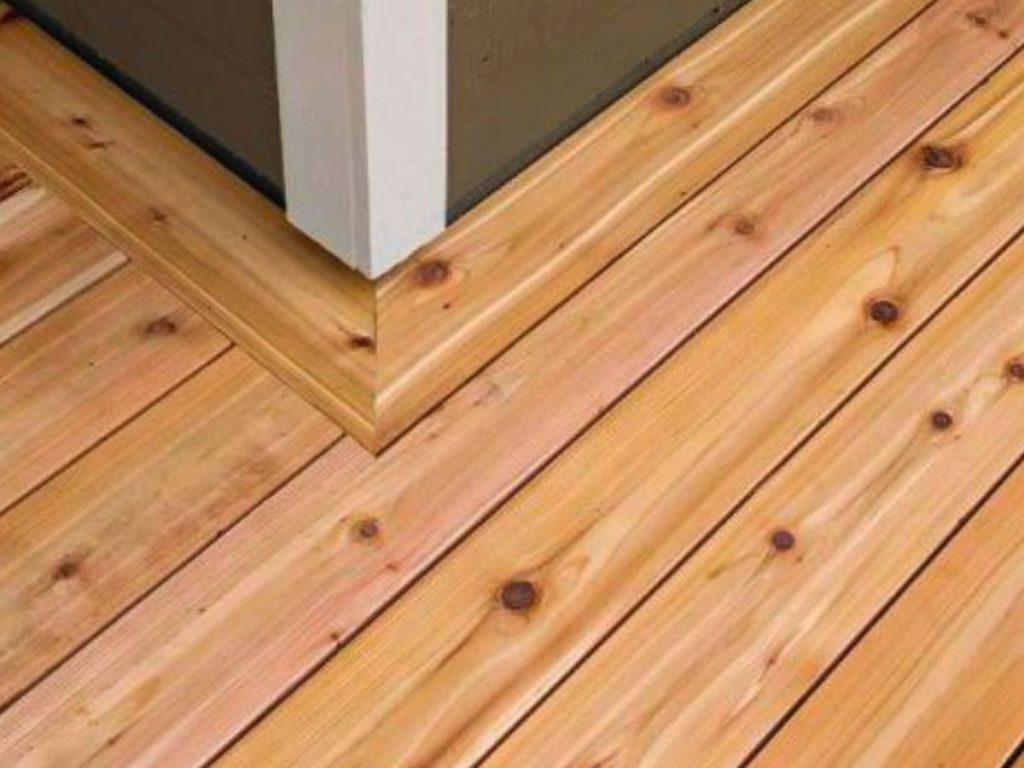
Cedar’s a natural wood that handles the Texas climate well if you stay on top of maintenance, but it fails quickly if you don’t. The cedar deck installations we do focus on Western Red Cedar specifically because it’s rot-resistant, dimensionally stable, and complements most Austin home styles.
UV exposure is cedar’s biggest vulnerability in Texas. Untreated cedar turns silver-gray in about 18 months and begins to show fiber breakdown by year three. Resealing every 2 to 4 years with a quality penetrating sealer reverses most of this. Skipped resealing accelerates the decline noticeably.
Heat performance is cedar’s quiet strength. Natural wood doesn’t heat up the way composite does. A cedar deck in full Texas sun runs noticeably cooler underfoot than an equivalent-color composite deck, which matters for barefoot use through Texas summer. The dimensional movement that comes with temperature swings is more pronounced on cedar than on composite. Still, with proper installation (correct fastener spacing, end-cut sealing, ground clearance), the movement doesn’t cause performance issues.
Humidity sensitivity is cedar’s main maintenance driver. Cedar absorbs and releases moisture seasonally, which causes some surface texturing over time. Many of our South Austin cedar builds lean into that texturing as part of the wood’s character. That texturing is part of cedar’s character for some homeowners and a maintenance frustration for others. Sealing slows the absorption cycle and reduces visible texturing.
Freeze-thaw cycles damage unsealed cedar faster than sealed cedar. Water in surface cracks expands when it freezes, even briefly, and accelerates the crack. Annual cleaning and on-schedule maintenance care prevent most of this.
Ipe and Tropical Hardwoods: How They Perform
Ipe (Brazilian walnut), cumaru, and other tropical hardwoods perform exceptionally in the Texas climate but cost meaningfully more than cedar or composite upfront. We occasionally build with ipe when the budget allows, and the homeowner wants a long-lasting, natural wood.
UV degradation on ipe is slow. The wood’s dense, oily structure resists fiber breakdown for decades. Untreated ipe turns silver-gray like cedar, but at a slower rate, and its structural integrity remains intact for 40+ years even without resealing.
Heat performance is good. Like cedar, ipe doesn’t heat up the way composite does. Surface temperatures stay walkable on bare feet even in full Texas sun.
Humidity stability is also strong. Ipe’s high density and natural oils resist moisture absorption, so seasonal movement is minimal compared to cedar.
The trade-offs are real. Ipe costs significantly more per square foot upfront than either cedar or composite. Installation runs slower because the wood is dense enough to require pre-drilling every fastener. Maintenance is minimal, but the upfront investment is large.
Pressure-Treated Pine: When It’s Acceptable
Pressure-treated pine (PT) is the budget tier and the right choice for some applications, but not most. It handles Texas humidity reasonably well because of the chemical treatment. UV degradation hits PT faster than cedar, though. Annual sealing is required to keep PT looking acceptable, and even with sealing, color and surface quality decline noticeably by year ten.
We use PT for substructure framing in deck replacement projects, where the wood is protected from UV exposure and remains structurally stable for decades. We don’t typically recommend PT as the surface board on new builds because the long-term aesthetic decline doesn’t match the build investment.
How We’d Recommend by Exposure Type
For full-sun lots (south or west exposure, minimal shade): composite in lighter colors. The UV and heat protection of the composite outperforms that of any natural wood option without resealing, and lighter colors keep the surface walkable.
For mixed-exposure lots (partial shade, morning sun only, or oriented away from afternoon sun): cedar works well if you’re committed to the resealing schedule. The shade reduces UV stress and extends the time between reseal cycles.
For shaded lots (significant tree canopy, north exposure, covered patios): cedar’s an easy choice. UV stress is reduced enough that resealing cycles stretch toward the longer end of the 2- to 4-year range, and the natural wood reads more authentically in shaded settings.
For pool deck applications and water-adjacent builds, TimberTech AZEK (PVC) outperforms both composite decking and cedar decking. Chlorine and standing-water exposure stress wood-fiber materials more quickly than dry-surface installations.
For traditional and historic homes (Central Austin neighborhoods, craftsman bungalows, 1920s-1940s housing stock): cedar or ipe. Composite reads architecturally wrong on these homes, regardless of which composite tone you pick.
How We Help You Decide
We bring physical samples of every material we install to the site walk, and we walk through lot exposure, planned use, and maintenance tolerance before recommending a direction. The right material is the one that fits your home’s climate exposure, your patience for upkeep, and your aesthetic preferences. Schedule a lot-exposure walkthrough, and we’ll cover the material decision with samples in hand and exposure-specific recommendations.