
Commercial Deck Builders for the Austin Metro
Majestic builds commercial decks across Austin and Hays County for multi-family, restaurant, hospitality, and office properties. We engineer commercial load ratings with ADA-compliant access, fire-code materials, and rigorous plan review, and we phase the work to keep your property operating. Fully insured, 1,000+ projects since 2016.
Commercial deck construction runs on a different rulebook than residential. The loads are higher, the code requirements are stricter, accessibility is mandatory, and the consequences of cutting a corner are measured in liability rather than inconvenience. We build commercial decks across the Austin metro and Hays County for multi-family, restaurant, hospitality, and office properties, and we don’t approach a commercial build the way we’d handle a backyard deck. Every project is engineered and built to the commercial standard from the ground up. Our commercial team is fully insured for commercial construction, and we carry the documentation that commercial clients and their insurers require.
The commercial work we take on falls into a few categories. Multi-family residential, where apartment and condo communities need durable shared deck and balcony structures that handle constant use. Restaurant and bar patios, where outdoor dining space directly drives revenue and has to look as good as it performs. Hospitality decks for hotels and event venues, and office and retail outdoor spaces, where employers and tenants increasingly expect usable exterior areas. Schedule a commercial consultation, and we’ll scope the project against its specific use and code path.
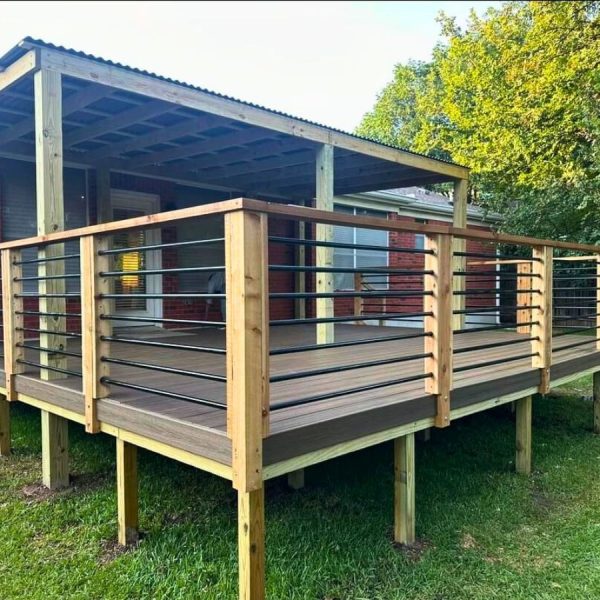
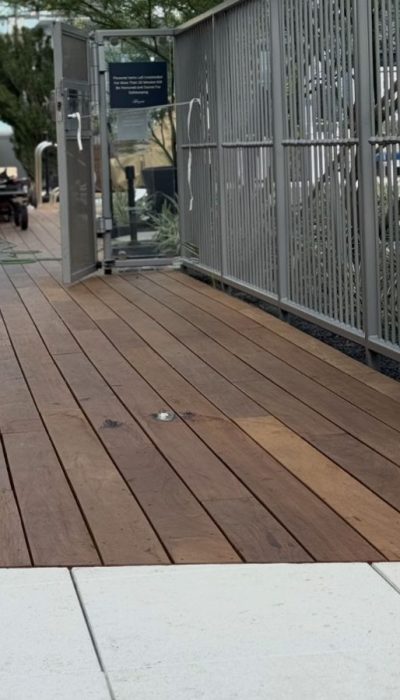
Commercial Deck Construction Standards
Load ratings are the first place commercial diverges from residential. A residential deck is engineered for a live load of 40 pounds per square foot. Commercial assembly occupancies, such as a restaurant patio or an apartment amenity deck, are engineered for higher live loads due to the density of people they accommodate. We engineer commercial decks to the occupancy classification the project falls under, which means heavier framing, closer joist spacing, and more substantial footings than a standard deck installation of the same footprint. It’s a fundamentally heavier structure, and there’s no shortcut around that.
Accessibility is mandatory on commercial projects, not optional. Commercial decks must meet ADA access requirements, which govern ramp design, surface transitions, clearances, and railing specifications. A restaurant patio or apartment amenity deck that isn’t accessible can’t be permitted, and retrofitting accessibility after the fact is far more expensive than designing it in from the start. We build ADA compliance into the design from the start because it shapes the structure rather than being bolted on at the end.
Fire code adds another layer that residential work rarely touches. Depending on occupancy and proximity to the building, commercial decks may require fire-rated materials, specific clearances, or non-combustible construction. We specify materials that meet the applicable fire requirements, which in many cases point to rated composite materials with the appropriate flame-spread rating or to other rated assemblies. The code path determines the material list, so we’ll establish it before specifying anything.
Material durability matters more under commercial use because the traffic is relentless. A residential deck sees a family. A commercial deck sees hundreds of people a week, every week. We lead with composite on most commercial projects because it withstands heavy foot traffic, resists the staining and wear that plague wood in high-use settings, and won’t require the ongoing maintenance that matters when the owner’s responsible for a large surface area. For custom commercial design, we integrate the deck with the building’s architecture, branding, and operational flow.
Commercial permitting and inspections are more rigorous than residential ones, and the timeline reflects that. Commercial projects go through commercial plan review, which examines structural engineering, accessibility, fire compliance, and often mechanical and electrical integration for lighting and outdoor equipment. Our permit partners handle commercial filings, and we build the engineered documentation into the submittal package. Our project sequencing outlines how we coordinate engineering, permitting, and phased construction to keep a commercial property operating throughout the work.
Phasing and business continuity separate commercial projects from residential ones operationally. A restaurant can’t close its patio throughout an entire build during peak season, and an apartment community can’t take its only amenity deck offline indefinitely. We sequence commercial construction to keep as much of the property as possible usable, scheduling disruptive phases during off-peak periods and staging the work to maintain access. The construction plan accounts for the business, not just the structure, because a project that shuts down a client isn’t one we’d be proud of.
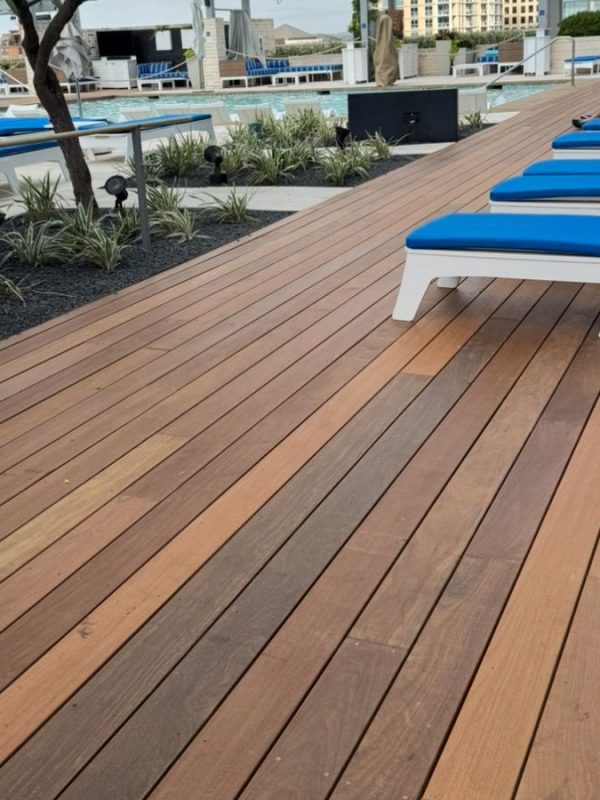
Commercial Deck Construction Across the Austin Metro
We build commercial decks throughout the Austin metro and Hays County, including South Austin and Buda, where multifamily development and commercial corridors have grown rapidly.
Growth in Kyle and the southern Hays County markets has brought new apartment communities, retail centers, and restaurants that need commercial outdoor space built to code, and we serve those markets with the same engineered approach.
The commercial quote is structured for the way commercial clients work: itemized by phase, with the engineering, permitting, materials, and labor broken out so owners, property managers, and their finance teams can see exactly what each component costs. We provide the insurance documentation, lien waivers, and compliance records that commercial projects require. A commercial deck’s a revenue and liability asset at once, so we build it to perform on both counts for the long haul.
Frequently Asked Questions
How is commercial deck construction different from residential?
Commercial decks are engineered for higher live loads based on occupancy classification, must meet ADA accessibility requirements, often require fire-rated materials, and go through a more rigorous commercial plan review. The construction also has to account for business continuity, keeping a property operating during the work. Residential decks face none of these as hard requirements, so commercial projects carry heavier framing, stricter compliance, and more involved permitting.
What types of commercial properties do you build decks for?
Multi-family residential (apartment and condo communities needing shared decks and balconies), restaurant and bar patios where outdoor dining drives revenue, hospitality decks for hotels and event venues, and office and retail outdoor spaces. Each has a different occupancy classification and code path, which we scope at the consultation. The engineering and material specifications follow from the project’s specific use and occupancy.
Do commercial decks have to be ADA accessible?
Yes. Commercial decks must meet ADA access requirements, which govern ramp design, surface transitions, clearances, and railing specifications. A patio or amenity deck that isn’t accessible can’t be permitted. We build ADA compliance into the design from the start, because it shapes the structure rather than bolting on at the end, and retrofitting accessibility after construction is far more expensive than designing it in.
What materials do you use for commercial decks?
We lead with composite decking on most commercial projects because it withstands heavy foot traffic, resists stains and wear, and requires low maintenance across large surfaces. The fire code may require specific flame-spread ratings or non-combustible assemblies, depending on occupancy and proximity to the building. The code path determines the material list, so we establish the requirements before specifying anything for the project.
Can you build a restaurant patio without closing the restaurant?
We sequence commercial construction to keep as much of the property as possible usable, scheduling disruptive phases during off-peak periods and staging the work to maintain access. A restaurant can’t close its patio during an entire build during peak season, so the construction plan accounts for the business, not just the structure. We scope phasing and business continuity into the project plan from the start.
What documentation do you provide for commercial projects?
We provide the insurance documentation, lien waivers, and compliance records that commercial projects require, along with the engineered drawings included in the permit submittal. The quote is itemized by phase, with engineering, permitting, materials, and labor broken out so owners, property managers, and finance teams can see what each component costs. We carry the documentation that commercial clients and their insurers require throughout the project.