
Multi-Level Deck Construction for Buda, Kyle, and South Austin
Majestic builds multi-level decks for sloped lots across Buda, Kyle, Driftwood, Wimberley, and South Austin. Two-tier, three-tier, and transitional designs sized to the actual grade drop of your lot. Trex Pro composite, TimberTech, cedar. Fully insured.
A sloped Hays County lot is a multi-level opportunity, not a problem to solve. Buda, Kyle, Driftwood, and Wimberley homes sit on grade drops that range from 4 to 15 feet across the deck footprint. The way the lot falls drives where the upper tier goes, where the lower tier goes, and where the transitions happen. There’s no template here. We start with a free site walk to measure the actual elevation change before we draw a line.
Two-tier decks separate dining from lounging across a small grade drop. Three-tier builds add a third zone, usually a pool or yard transition, at the bottom level. Wraparound configurations carry one tier around the corner of the house to capture a view from a second angle. Each design starts at the site, not in a template. Talk through a custom design at the consultation.
Material selection depends on tier exposure. Upper tiers see the most sun and weather, so composite holds up better than wood at the top. Lower tiers can be made of cedar or pressure-treated wood, as the budget allows. We’ll explain the trade-offs in person, using samples from completed builds across Hays County.
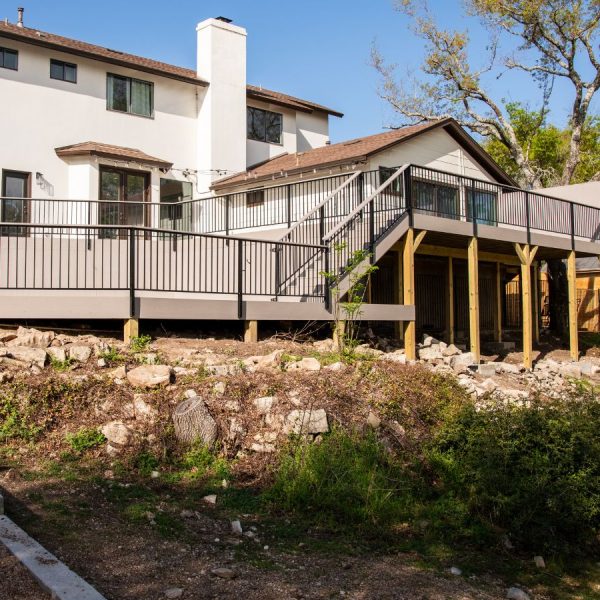
Multi-Level Configurations We Build
Five configurations cover the way Hays County and South Austin lots fall. Each design is sized to your grade drop, uses patterns, and is tier-appropriate. We don’t draw from a template library.
Two-Tier Decks
Two-tier decks divide the deck footprint into upper and lower zones over a 2- to 6-foot grade drop. Common pattern: upper tier off the back of the house for dining and grilling, lower tier closer to grade for lounging and yard access. Stair geometry connects the tiers. Two-tier is the entry point for sloped-lot multi-level work and the most common configuration we’ve built in Buda and Kyle.
Three-Tier Decks
Three-tier builds work on steeper grade drops between 6 and 15 feet. Upper tier handles dining at the house elevation. The middle tier holds lounging, a fire feature, or covered seating. Lower tier transitions to pool, yard, or hillside. You’ll most often see a three-tier on Driftwood and Wimberley acreage, where the lot configuration justifies it.
Transitional Step-Down Designs
Transitional step-down designs handle smaller grade drops (2-3 feet) where a full two-tier separation isn’t worth the stair run. Step-down zones create visual separation between dining and lounging without requiring full stair connections. Useful on flatter Cedar Park or Round Rock lots where the homeowner wants the multi-level look without the multi-level cost.
Wraparound Configurations
Wraparound configurations carry one tier around the corner of the house to capture a view from a second angle. Common on Driftwood and Wimberley lots with Hill Country views to the south or west. Either the wraparound becomes the upper tier, or it sits at grade with the main tier close to the house.
Multi-Level Pool Deck Integration
Multi-level configurations integrate with pool deck design when the lot includes an in-ground pool. Upper tier off the house for entertaining, middle tier as the pool-edge sun deck, optional lower tier as a yard or shade-zone transition. Composite material handles chemical exposure around the water better than wood. You don’t want wood at the pool-adjacent tier; the cycling shortens its life.
Why Majestic for Multi-Level Builds
Multi-Level Is Our Lead Service Category
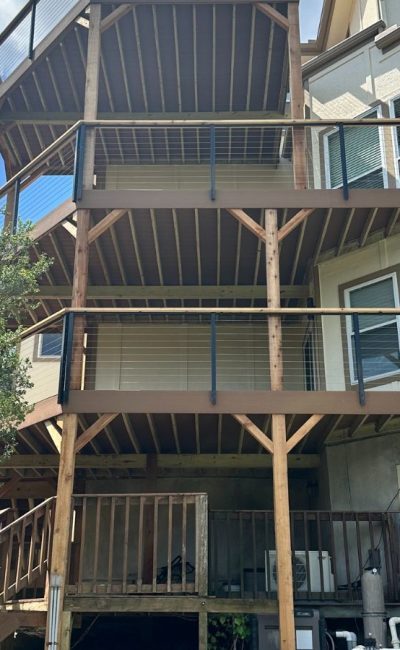
Most Austin deck builders treat multi-level decks as a single feature in a custom build. We treat it as the lead service category. The team has built two-tier, three-tier, and wraparound decks across Buda, Kyle, Driftwood, and Wimberley as the bulk of our portfolio since 2016. We’re not learning multi-level on your project; we lead with it.
Hays County Limestone Substrate Expertise
Hays County limestone substrate shapes how we design multi-level decks. We measure actual elevation change at the site walk, not from a survey. We’ve been doing this since 2016 because surveys can’t catch the variations that affect stair stringer geometry, tier transition heights, and footing locations.
Tier-Optimized Material Selection
Upper tiers face the most sun and weather, so we lead with Trex Pro composite there. TimberTech is available for premium specs where design calls for it. Middle and lower tiers can be cedar or pressure-treated wood, where the budget calls for it. The cost difference between all-composite and tier-optimized material runs 20 to 30 percent on a typical three-tier build, and we’ll show you both quotes.
Same Crew From Foundation to Final Railing
You’ll meet the lead carpenter at the site walk. The same crew handles foundation, framing, decking, railing, and final inspection. No subcontractor handoffs. That’s a deliberate operational choice. Permit partners file paperwork through our about page network.
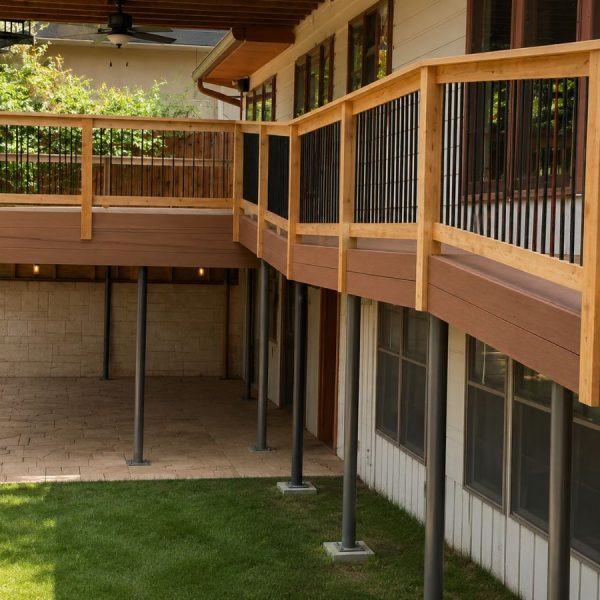
Multi-Level Service Area
Multi-level builds are concentrated in Buda and Kyle, where the Plum Creek and Vista Oaks subdivisions consistently experience grade drops of 4 to 12 feet. That’s the sweet spot for two-tier and three-tier work.
Driftwood and Wimberley extend our multi-level coverage further south and into the Hill Country fringe. There’s more room for tier separation here than in tighter subdivisions, so acreage areas around Driftwood and the steeper Wimberley lots tend toward three-tier and wraparound configurations.
Manchaca and the South Austin corridor round out the Hays-adjacent coverage. Multi-level work here often shifts to transitional designs because the lot grade drops are smaller. We’ll still walk the lot in person before recommending an approach.
For the broader Austin metro (Round Rock, Cedar Park, Georgetown, Pflugerville, Leander), multi-level work shifts toward transitional step-down designs on flatter lots. You don’t need a 12-foot grade drop to get a multi-level look. The grade drops are smaller, so the pattern shifts toward visual zone separation.
Hays County HOAs (Plum Creek, Whispering Hollow, Sunset Hills) require architectural committee review for multi-level builds. We prep the submittal package as part of the quote. Buda, Kyle, and Travis County require permits for elevated decks above 30 inches. Our permit partners handle the filings, so you don’t navigate the city or county process.
Frequently Asked Questions
What's the difference between a two-tier and a three-tier deck?
Two-tier decks separate upper and lower zones across a 2 to 6-foot grade drop, typically with dining above lounging. Three-tier adds a middle zone for steeper grade drops of 6 to 15 feet, usually for fire features, covered seating, or pool transition. Three-tier requires more foundation work and longer stair runs. Two-tier is the entry point for sloped-lot multi-level; three-tier maximizes deeper Hays County and Hill Country lots.
How much grade drop do I need for a multi-level deck?
Two-tier construction starts with about 2 feet of grade drop across the deck footprint. Below that, a transitional step-down design works better than a full tier separation. Three-tier construction requires a total grade change of 6 to 15 feet to make the middle tier cost-effective. Most Buda, Kyle, and Driftwood lots fall in the 4 to 12-foot range, which is the sweet spot for multi-level work.
What materials work best for multi-level decks in Hays County?
Upper tiers see the most sun exposure and weather cycling, so the capped composite holds up better than wood at the top. We lead with Trex Pro (we’re certified installers) and TimberTech for premium specs. Lower tiers can use cedar or pressure-treated wood where the budget allows. Tier-optimized material selection typically saves 20 to 30 percent over an all-composite build.
How long does a multi-level deck build take?
Two-tier builds typically take 2 to 3 weeks of construction once permits are issued. Three-tier and wraparound configurations take 3 to 5 weeks to complete, depending on size and material. Permit and HOA approval coordination adds 2 to 4 weeks to the start of construction. The total timeline from contract signing to final inspection is 6 to 10 weeks for most multi-level builds. Material lead times on premium composite can add a week.
Do I need a permit for a multi-level deck in Buda or Kyle?
Multi-level decks usually require permits because at least one tier sits more than 30 inches above grade. City of Buda, City of Kyle, Hays County, and Travis County all enforce the 30-inch threshold for elevated deck permitting. Our permit partners handle the filings, so you don’t navigate the process. HOA architectural committee approval runs in parallel and typically takes 2 to 4 weeks.
Can you integrate a multi-level deck with my pool?
Yes. Multi-level pool deck integration is one of our five primary services. Common pattern: upper tier off the house for entertaining, middle tier as a sun deck at pool elevation, optional lower tier as a yard or shade-zone transition. Composite material at pool-adjacent tiers handles chlorine and salt exposure better than wood. The lot configuration drives whether full tier separation makes sense around the water.
How do you handle HOA approval for multi-level builds?
We prep the architectural committee submittal package as part of the quote process. Plan view, elevation drawings, material specifications, and railing details all get formatted to the HOA’s submittal template. Plum Creek, Whispering Hollow, Sunset Hills, and the Hays County HOAs we’ve worked with previously all have known templates we can match. Submittal review typically runs 2 to 4 weeks.
What does a typical multi-level deck process look like?
Five phases. Site walk and grade measurement (week 1). Design and material specification (weeks 2 to 3). HOA submittal and permit coordination (weeks 3-6). Build from the foundation through the final railing (weeks 6 to 10, depending on the tier count). Final inspection and walk-through (week 10 to 11). Contact us to start with the site walk. We don’t quote work blind.