
Deck Builders for Central Austin's Historic Districts
Majestic builds decks across Central Austin, Texas, covering 78701, 78703, 78705, 78751, and 78756 ZIP codes. Historic-district HOA compliance, heritage tree preservation, infill builds on smaller lots, and rooftop decks on downtown condos. Fully insured. 1,000+ projects since 2016.
Central Austin sits at the center of the city’s design tension: smaller lots, older homes, denser neighborhoods, and the deepest concentration of historic-district and heritage-tree rules in the metro. We build decks across Central Austin, from the downtown condo corridors to the bungalows of Hyde Park, and every project starts with the constraints the neighborhood actually carries. The Majestic crew is fully insured and accustomed to working inside the City of Austin’s most restrictive design zones.
The core ZIPs we serve in Central Austin are 78701, 78703, 78705, 78751, and 78756. Each of these has a distinct character that drives what works on the deck. Schedule a Central Austin site walk, and we’ll cover the design and permit path for your specific block before any pricing comes up.
Neighborhoods and Project Patterns in Central Austin
Hyde Park is the neighborhood we work in most often in Central Austin, and it carries the strictest constraints. Local Historic District rules govern any visible exterior change, which, on a deck, means it’s design review for height, setbacks, and material choices facing the street. We’ve completed cedar deck builds in Hyde Park that needed Historic Landmark Commission review before permitting, and we know which design choices clear that review and which ones don’t.
Clarksville and Old West Austin sit west of MoPac with smaller lots and even older housing stock. Most homes here predate modern setback rules, so we’ll work with what’s already there. It complicates deck siting because the existing building footprints sometimes leave very little buildable space in the back. We work with custom-built solutions to fit the available footprint without triggering setback variance applications.
Tarrytown leans wealthier, and lot sizes run larger than in Clarksville, but mature live oaks dominate most yards. That’s why heritage tree protection drives most of the design work here, since the tree ordinance requires preservation of the critical root zone for any oak over 19 inches in diameter. That’s the rule we design around. Our deck builds in the Tarrytown route around protected root zones with deep pier footings outside the drip line. The same footing approach supports pool deck surrounds work on Tarrytown’s larger lots.
Rosedale, Allandale-adjacent blocks, and North Loop sit further north along the 78756 corridor. Housing stock runs mid-century with larger lots than the inner-loop neighborhoods. Multi-level deck builds work well here on the sloped lots near Shoal Creek, and we’ve delivered multi-level construction projects in Rosedale that step down toward the creek without compromising tree canopy.
The 78701 downtown ZIP is its own conversation. Most projects here are rooftop or balcony deck work on condos and mid-rise buildings, not ground-level builds. It’s a different kind of build entirely. Our rooftop deck installation work in downtown Austin uses pedestal-paver systems that protect the roof membrane and meet the structural and waterproofing requirements set by condo associations for any rooftop modification.
Historic district rules and HOA-equivalent neighborhood reviews are common across Central Austin. The City of Austin’s Historic Landmark Commission reviews changes in designated districts, and Hyde Park, Old West Austin, and several smaller pockets carry that designation. We handle the permit work and design review submittals as part of the build, so the homeowner doesn’t navigate the historic review process alone.
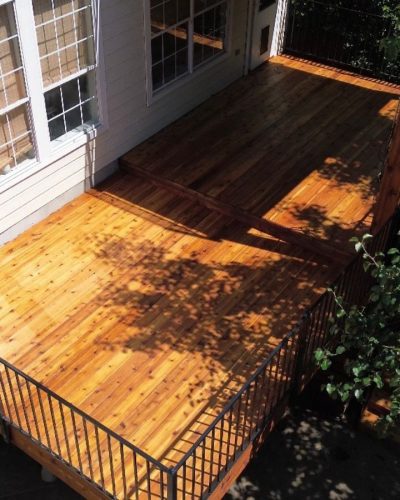
Heritage trees are everywhere in Central Austin, and the tree ordinance is real. Any oak, pecan, or other protected species over 19 inches in diameter requires preservation planning, and the critical root zone (roughly the area under the canopy plus a buffer) can’t be disturbed without an arborist letter and city sign-off. We’ll design decks to route footings outside protected zones and coordinate with an arborist when the design impacts a heritage tree.
Material choices in Central Austin lean toward natural wood in the historic and traditional neighborhoods (Hyde Park, Clarksville, Tarrytown) and toward composite materials for modern infill builds and rooftop projects. We bring physical samples to the site walk, so the material choice fits the architecture rather than fighting it. The build approach covers the design and material conversation in detail.
Lot sizes in Central Austin are usually smaller than the suburban Hays County markets, which changes the design conversation. A 30-foot-wide lot in Clarksville won’t support the same multi-tier, multi-zone deck a half-acre Driftwood lot does, and we lean into compact design solutions: wraparound builds. These integrated benches conserve space, and stepped designs that use grade rather than expanding outward.
We serve the full Central Austin footprint, with most work concentrated in South Austin-adjacent zones around 78704 and the inner-loop neighborhoods. Schedule density is heaviest in Hyde Park, Clarksville, and Tarrytown, and we plan crew routing to keep travel time off the project clock.
Driftwood and the Hill Country markets are a separate conversation from Central Austin, but plenty of Central Austin homeowners have second homes or family property out in Driftwood and Wimberley. We’re the same crew on both kinds of projects, but the design conversations differ entirely because the constraints are different.
The Central Austin permit timeline for City of Austin deck permits runs 4 to 8 weeks, which is slower than in Hays County. Historic district review adds 2 to 4 weeks, when applicable. Our permit partners handle everything, and we’ll build a realistic timeline into the project schedule so there are no surprises mid-build.
Frequently Asked Questions — Central Austin Deck Projects
What Central Austin ZIP codes do you serve?
We cover 78701 (downtown), 78703 (West Austin, Clarksville, Tarrytown), 78705 (UT area), 78751 (Hyde Park), and 78756 (Rosedale, North Loop). These are the historic-district and inner-loop neighborhoods where most of our Central Austin work happens. We’ll also handle adjacent ZIP codes on a case-by-case basis when projects come up through neighborhood referrals.
How do you handle Hyde Park's Local Historic District design review?
Any visible exterior change in Hyde Park triggers Historic Landmark Commission review covering height, setbacks, and material choices facing the street. We’ll design the deck to clear that review the first time, with material choices and proportions that fit the neighborhood character. The Historic Landmark Commission submittal becomes part of the permit package our permit partners file.
Can you build on Clarksville's small lots without setback variance?
Most of the time, yes. It’s tighter than the suburbs but workable. Clarksville lots are tight, but with careful siting, the deck fits inside the existing setback envelope. Variance applications add 2 to 4 months to the timeline and are often denied, so we design around the constraints rather than fight them. If a variance’s truly necessary, we’ll walk you through the realistic odds before you commit to that path.
Do you work on Central Austin rooftop and condo decks?
Yes. Most of our 78701 downtown work is rooftop or balcony deck construction on condos and mid-rise buildings rather than ground-level builds. We’ll use pedestal-paver systems that protect the roof membrane and meet the structural and waterproofing requirements of condo associations. The condo association review runs in parallel with the city permit.
How does Austin's heritage tree ordinance affect a Central Austin deck design?
Any oak, pecan, or other protected species over 19 inches in diameter triggers the tree ordinance. The critical root zone (the area under the canopy plus a buffer) can’t be disturbed without an arborist letter and city sign-off. We’ll design decks to route deep pier footings outside protected zones and coordinate with an arborist when the design impacts a heritage tree.
How long does a deck permit take in Central Austin?
City of Austin deck permits run 4 to 8 weeks for review, which is slower than Hays County. Historic district review adds 2 to 4 weeks, when applicable. Our permit partners file the paperwork and track the review process, and we’ll build a realistic timeline into the project schedule so there are no surprises mid-build. We’ll give a specific estimate at the site walk.
Is composite or natural wood a better fit for Central Austin?
It depends on the neighborhood. There isn’t one answer that fits every block. Hyde Park, Clarksville, and Tarrytown lean toward natural wood for the traditional and historic homes, and cedar usually fits the architecture best. Modern infill builds and rooftop projects often suit composite, which’ll carry a longer service life with less maintenance. We bring physical samples to the site walk, so the material choice fits the home rather than fighting it.