
Deck Builders for Cedar Park's Modern Tract Homes
Majestic builds decks across Cedar Park, Texas, covering 78613 and 78630 ZIP codes. Modern composite installation on 2000s and 2010s tract homes, master-planned subdivision work, HOA design submittal management, and Brushy Creek corridor builds. Fully insured. 1,000+ projects since 2016.
Cedar Park’s grown into one of the largest cities in Williamson County, and the deck work here reflects that: most homes are 15 to 25 years old, sitting in master-planned subdivisions with active HOAs and modern architecture that suits composite decking better than traditional cedar. The conversations we have here look different from those in the older Travis County markets, where heritage trees and historic districts drive design choices. In Cedar Park, it’s usually the subdivision design review board that is the bigger constraint. The Cedar Park team is fully insured and accustomed to the HOA submittal process that defines Williamson County work. Past Cedar Park builds include projects across Avery Ranch, Brushy Creek, and the older Buttercup Creek subdivision.
The ZIP codes we serve in Cedar Park are 78613 and 78630, which cover the city’s entire residential area. Book a Cedar Park site walk, and we’ll cover the design conversation and HOA process for your specific subdivision.
Neighborhoods and Project Patterns in Cedar Park
Buttercup Creek’s one of Cedar Park’s most established subdivisions. Houses here are 20 to 25 years old, sitting on quarter-acre lots that support full-platform deck builds. The original decks installed with these homes have mostly reached the end of their useful life, and replacing them with current-generation composites is a common project. We’ve handled several full-deck replacements across Buttercup Creek where the original framing was sound, but the surface boards needed replacement.
Brushy Creek runs along the south side of Cedar Park and ties into Round Rock to the east. The housing stock is a mix of 1990s and 2000s tract homes with mid-sized backyards. Pool deck work runs heavy in Brushy Creek because many homes added pools in the 2000s, and the pool surrounds from that era often need replacement. We do significant pool deck installation work in Brushy Creek, covering both new builds and pool surround replacement. Targeted deck repair on aged pool surrounds runs the same crew.
Avery Ranch is one of Cedar Park’s newer master-planned communities, developed in the mid-2000s and continuing through the 2010s. Homes here suit modern composite better than natural wood, with charcoal and gray finishes that match the contemporary architecture. Avery Ranch’s HOA has an active design review process, and we’ll prepare the elevation drawings and material specs the review board needs for approval. New-construction homes often require installation work on a builder’s timeline, which moves faster than that of retrofit projects.
Forest Oaks, Twin Creeks, and the 1431 corridor subdivisions on the west side of Cedar Park run through 78613. These are 2000s and newer master-planned communities with HOA-driven design standards. The deck conversation here usually centers on either new construction on lots that didn’t originally include decks or upgrades from concrete patios to elevated decks.
The older neighborhoods near downtown Cedar Park (along Park Street and the older 78613 grid) feature mid-1990s-era and earlier housing stock, mature trees, and slightly smaller lots. These don’t have the strong HOA presence that newer subdivisions do, which makes the permitting process simpler. Williamson County deck permits typically clear in 3 to 5 weeks for these older neighborhoods.
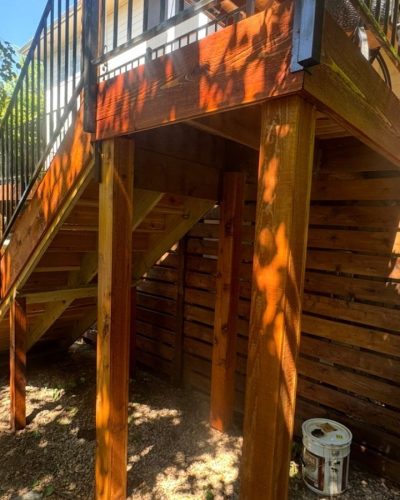
Cedar Park’s HOA concentration is among the highest in the metro, and that’s a real factor in project timelines. Almost every subdivision built after 2000 has an active design review board, and the approval process runs in parallel with the city permit process. We’ve completed submittal packages across Avery Ranch, Twin Creeks, Forest Oaks, and Brushy Creek, so we know the design preferences each association looks for: clean railing styles, neutral material finishes, and elevations that don’t break the subdivision’s visual character.
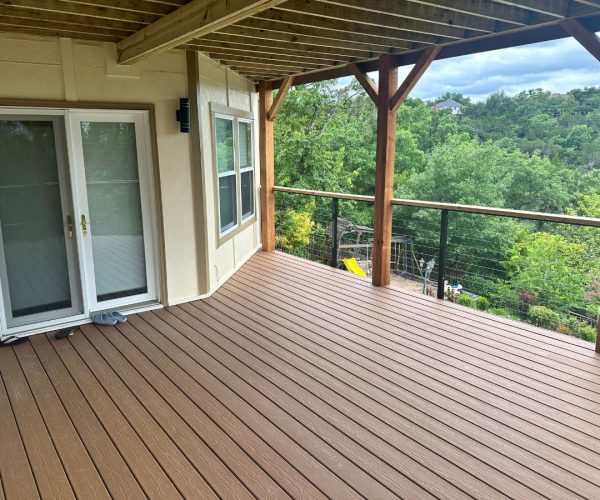
Material choices in Cedar Park lean heavily toward composite materials because the modern architecture in most subdivisions suits gray and charcoal composites better than natural wood tones. Older neighborhoods near downtown still see cedar work where the traditional housing stock fits it. The choice usually becomes clear once we hold material samples up against the home’s existing exterior during the site walk.
Lot sizes in Cedar Park are larger than those in the inner-Austin sections we work in, but smaller than the rural Hays County acreage. Most subdivision lots run between a quarter and a third of an acre, which accommodates full-platform deck builds with room for outdoor kitchen or fire pit integration if the homeowner wants it. Fully custom design for these outdoor feature integrations runs about 20 percent of our Cedar Park volume.
The Williamson County permit timeline for Cedar Park work runs 3 to 5 weeks, which is faster than the City of Austin process. HOA review adds 3 to 4 weeks and runs in parallel with the city permit. The total timeline is predictable once we file, and the build framework builds the review periods into the project schedule from the start.
We also serve adjacent Williamson County markets and the broader Austin metro. Cedar Park homeowners will often have second homes or rental property nearby, and we handle work in Round Rock, Leander, and Georgetown with the same crew. The constraints vary slightly across markets, but the design and permitting processes share common ground throughout Williamson County.
Frequently Asked Questions — Cedar Park Deck Projects
What Cedar Park ZIP codes do you cover?
We work across both Cedar Park ZIPs: 78613 covers most of the city, including downtown, Avery Ranch, Forest Oaks, and the older neighborhoods, while 78630 covers the Twin Creeks area and parts of the west side. These two ZIPs cover the city’s full residential footprint, and they’re treated as a single service area. Adjacent Williamson County ZIPs are handled on a case-by-case basis when projects come up through referrals. They’re not a regular service area.
How active are HOAs in Cedar Park subdivisions?
Cedar Park’s HOA concentration is among the highest in the metro, and that’s a real factor in project timelines. Almost every subdivision built after 2000 (Avery Ranch, Twin Creeks, Forest Oaks, Brushy Creek) carries an active design review board with elevation, material, and railing standards. We’ve completed submittal packages across all the major subdivisions, and we know the design preferences each association looks for at review.
Is composite or cedar a better fit for Cedar Park homes?
Composite wins most Cedar Park projects. That’s especially true for new construction. The modern architecture across Avery Ranch, Twin Creeks, and the newer master-planned subdivisions suits gray and charcoal composite better than traditional cedar tones. Older neighborhoods near downtown still see cedar work where the housing stock fits it. We’ll bring physical samples to the site walk and hold them against the home’s existing exterior.
Do you handle Buttercup Creek deck replacement?
Yes, it’s one of our common project types in Cedar Park. The original decks installed with Buttercup Creek’s 20- to 25-year-old homes have mostly reached the end of their useful life, and replacement with current-generation composites is the right call when the surface boards’ve degraded but the original framing’s still sound. We’ll inspect the site and give you an honest assessment during the site walk.
What's the Cedar Park permit timeline for deck construction?
City of Cedar Park and Williamson County permits allow a clear review in 3 to 5 weeks, which is faster than the 4 to 8 weeks City of Austin requires. HOA review adds 3 to 4 weeks running parallel with the city permit, not sequentially. The total timeline runs about 6 to 9 weeks from contract to permit issuance, and we’ll build that into the project schedule from the start.
Can you build an outdoor kitchen and fire pit integration on Cedar Park decks?
Yes. Outdoor feature integration accounts for about 20 percent of our Cedar Park volume, mostly on Avery Ranch, Twin Creeks, and the larger Brushy Creek lots, where the backyard supports the additional footprint. We’ll coordinate the design across all features (deck, kitchen, fire pit, pergola) rather than approaching them as separate add-ons, so the finished outdoor space reads as one cohesive build.
Do you work on pool deck surrounds in Brushy Creek?
Yes. Pool deck work runs heavy in Brushy Creek because many homes added pools in the 2000s, and the original surrounds from that era often need full replacement now. We’ll cover the technical details at the site walk: expansion gaps, drainage routing, slip-resistant texture at the pool edge, and chlorine-rated material selection for surfaces that take regular pool splash.