
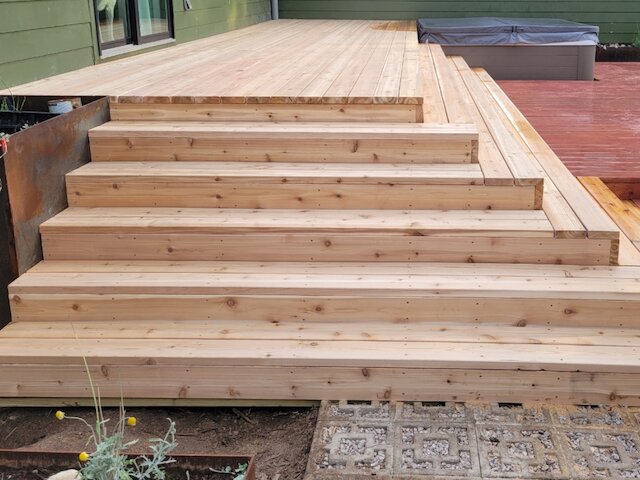
Most homeowners considering DIY deck repair are weighing the math wrong. They’re comparing the material cost (the home improvement store invoice) against the contractor’s all-in price (materials, labor, permits, warranty, and time). It looks like DIY wins by a wide margin on paper. That’s a tempting picture. In practice, the wider picture often doesn’t.
We see this every year during follow-up repair calls we get called for after a homeowner started a DIY repair and ran into something they couldn’t finish. That’s not us pushing professional service for its own sake. Some deck repairs genuinely make sense as homeowner projects. Others don’t, and knowing the difference saves both money and frustration. Robert and the build team have a clear view of where each line falls after seeing the full range of DIY outcomes.
When DIY Genuinely Works
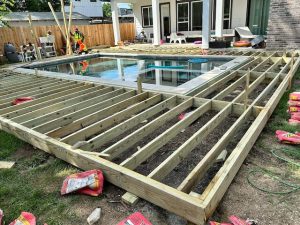
Four repair scopes are reasonable DIY projects for most handy homeowners:
Single board replacement: replacing one or two damaged surface boards on an otherwise sound deck. Tool requirements are minimal (drill, saw, pry bar). Skill barrier is low. The risk of cascading problems is small.
Surface cleaning and refinishing: pressure washing, cleaning, applying stain or sealer. This is recurring maintenance work, not structural repair. Most homeowners can do it well with a weekend and modest equipment. The main risk is using the wrong product or improper prep, which shortens the finish’s life but doesn’t cause structural problems.
Railing component replacement: replacing a damaged baluster, swapping out a section of railing infill, or refastening a loose handrail. Provided the railing’s overall structure is sound, individual component swaps are manageable DIY work.
Stair tread replacement: replacing one or two warped or damaged tread boards on existing stair stringers. The stringers themselves are structural; the treads aren’t.
These four scopes share characteristics that make DIY work: localized scope, minimal tools, low structural risk, and no code compliance triggers. If your repair fits one of these categories, DIY is a reasonable choice.
When DIY Often Goes Wrong
Structural repair is where DIY projects most commonly become expensive lessons. Five categories specifically:
Joist or beam replacement: requires accurate load calculations, properly sized lumber, code-compliant hangers, and the experience to know when surrounding members also need attention. The work itself isn’t beyond a skilled DIYer, but the knowledge of which adjacent components also need updating usually isn’t there. We’ve seen DIY joist replacements that fixed one rotted joist while leaving four others, visible from underneath, on the verge of failure. A formal structural assessment usually identifies all the work together.
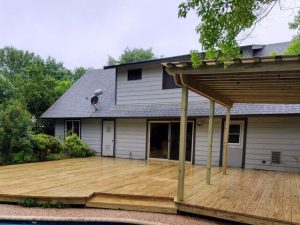
Ledger replacement: this is the highest-risk DIY repair we see. Improper ledger work has caused fatal deck collapses nationally. Modern code requires specific lag bolts or structural screws (not nails or standard wood screws), proper flashing detail, and connection to the house framing (not just sheathing). DIY ledger work without proper hardware and flashing detail often passes initial use and fails years later. By the time it fails, the homeowner who did the work may have sold the house, leaving the next owner with a hidden problem. We’ve seen this pattern repeat across Cedar Park subdivisions where the new owner inherited the failure from a previous DIY repair.
Post or footing work: requires concrete work, soil assessment, and load calculation. Even handy homeowners often underestimate the depth, diameter, and concrete mix specifications required for Austin’s expansive clay soil. Improper footings heave or settle, and the damage shows up years later when the deck moves visibly. Our project workflow includes footing inspection and load calculation as a separate phase before any work is committed.
Fastener replacement at scale: replacing a few visible fasteners is reasonable DIY work. Replacing fasteners throughout the structure (often necessary when corrosion is widespread) requires removing every surface board, accessing every joist hanger, and reinstalling everything to spec. The work itself is straightforward; the time investment is enormous and often underestimated by a factor of 3 to 5. Routine maintenance work prevents the underlying corrosion conditions that trigger this scale of repair.
Multi-level or rooftop repairs: the structural complexity of multi-level builds compounds the difficulty of repairs. What looks like a localized repair often requires working across multiple levels, managing load transfer between tiers, and accessing connections that aren’t visible from any single vantage point.
The Hidden Cost Categories DIY Quotes Miss
DIY cost comparisons typically include material cost. They typically miss several other categories that show up as line items during professional repair but are silently absorbed in DIY work.
Tool acquisition: a professional deck builder’s tool kit includes circular saws, miter saws, framing nailers, oscillating multi-tools, impact drivers, levels in multiple sizes, square sets, and specialized hardware. Buying or renting these for one repair often costs more than the labor savings vs hiring out.
Permits: structural repair triggers permit requirements in Austin and most surrounding jurisdictions. Pulling a residential permit as a DIY requires submitting drawings, paying application fees, and scheduling inspections. Our permit partners handle this end-to-end as part of the professional repair scope. DIY work that should have been permitted but wasn’t can create insurance and resale problems later.
Disposal: deck demolition generates significant waste, and waste disposal in the Austin area isn’t free. Construction debris requires either a roll-off rental or multiple trips to transfer stations. Professional repair scope includes disposal; DIY usually doesn’t until you’re staring at a pile of old deck boards.
Warranty coverage: professional work carries a warranty on both labor and materials. DIY work doesn’t, which means if something fails in year 2 or 3, the homeowner pays again to fix what they already paid to fix once.
Insurance and liability: professional contractors carry liability insurance for the work. DIY repairs that cause damage (water damage to the house, structural failure, or injury to a visitor) place liability directly on the homeowner. For most homeowners, this never matters; for the ones it does, it matters significantly.
Time: the most invisible cost. A repair that takes us 3 days might take a skilled DIYer 3 weekends. Multiply the homeowner’s hourly rate by the hours spent, and the DIY “savings” often disappear entirely.
The Specific Risks of Cutting Corners
DIY repairs that skip code compliance or proper hardware often work well for 1 to 3 years, then fail in years 5 to 8. By then, the homeowners typically moved on emotionally, and the failure feels like bad luck rather than the consequence of a specific shortcut.
The most common shortcut categories we see during deck replacement consultations on DIY-repaired decks: standard wood screws used in place of structural screws, exterior-rated screws but not code-rated for deck ledger applications, missing flashing at deck-to-house joints, undersized joist hangers, footing depth insufficient for soil conditions, and ground-contact lumber not used where code requires it.
None of these failures is catastrophic in year one. All of them become structural problems within a decade. By that point, the deck either gets replaced (often by a different owner who inherits the problem) or requires substantially more repair than the original work would have cost to have been done professionally.
When Professional Repair Genuinely Makes Sense
The practical answer for most homeowners isn’t “always DIY” or “always hire out.” It’s matching the scope to the right path.
For cosmetic repair on a structurally sound deck (board replacement, refinishing, railing components), DIY is a reasonable choice if you have the skill and time.
For anything involving the structural framing, the ledger, the posts, or the footings, professional repair almost always wins out in long-term value, even though the upfront cost is higher.
When selling within 5 years, professional repairs with documentation (permits pulled, warranty in place) support resale better than DIY work, which buyers and inspectors often discount or flag.
When keeping the deck long-term, the question is which path actually gets you a deck you can use for the next 20 years. Professional repair on a sound structure usually delivers that. DIY repair on a sound structure can deliver that, given skill and time. DIY repair on a borderline structure usually doesn’t.
Book a scope walkthrough, and we’ll tell you honestly which scope is DIY-friendly and which is worth hiring out, specific to your deck. Past repair outcomes across the metro show what professional work looks like at various scopes.