
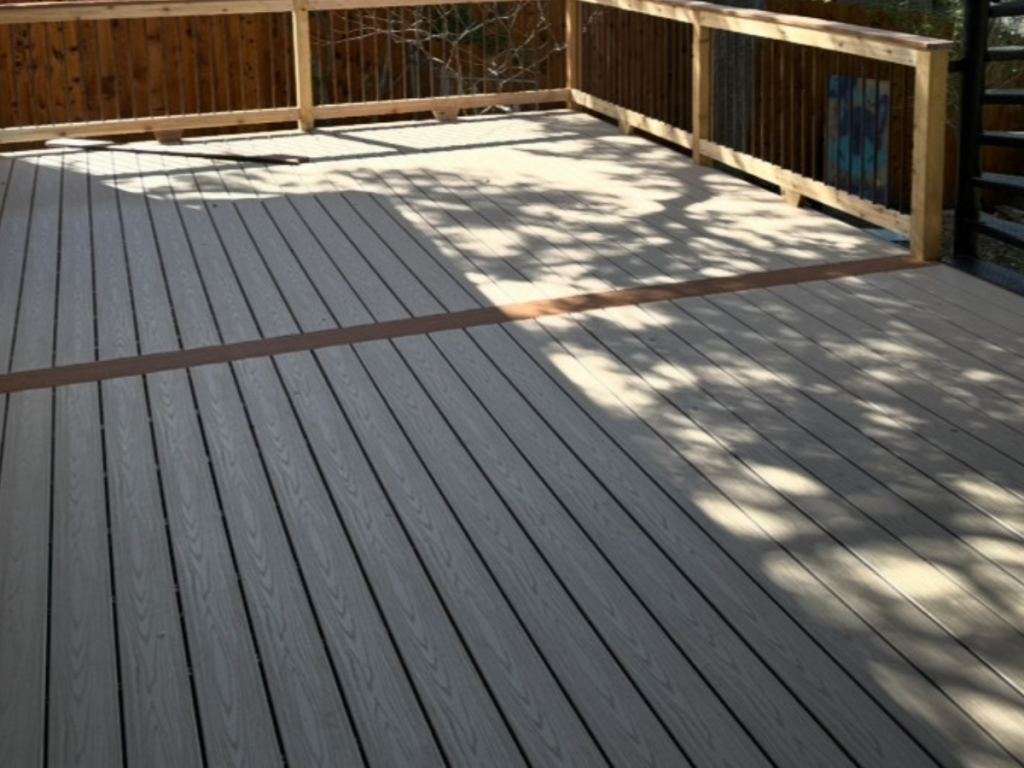
The single most expensive part of any deck is the structural framing underneath the surface boards. If the framing’s sound, almost any surface issue is repairable economically. That’s the good news for many aged decks. If the framing’s compromised, even pristine surface boards don’t make the deck worth keeping. It’s the harder reality of structural decay. Assessing the framing condition tells you whether it’s a repair or a replacement before calling a contractor.
The framing assessment determines whether the deck is a repair candidate or a replacement candidate. This guide walks through the specific structural categories we check during inspections across Hays, Travis, and Williamson counties, what passes and what fails in each category, and how these categories combine to produce the final repair-or-replace recommendation. Robert and the assessment team inspect for these conditions on every consultation. For the broader decision framework, the repair vs replacement guide covers when each path makes sense once the framing assessment is complete.
The Five Framing Categories We Assess
Deck structure splits into five distinct categories. We assess each one independently because they fail differently, and each has its own salvage criteria.
Joists are the parallel boards that span between beams and support the surface decking. Beams are the larger members that carry joist loads and span between posts. Ledger is the board attached to the house that supports one end of the joist run. Posts are the vertical members that carry beams down to the footings. Footings are the underground concrete or pier supports that transfer load to stable soil.
Any one of these failing seriously tips a deck toward replacement. Multiple soft failures across categories add up faster than the homeowner realizes. The framework below applies the structural standards we use in the field.
Joists: What Passes, What Fails
Joists fail in three ways: structural rot, dimensional instability, and connection failure.
Structural rot shows up as brown, soft, crumbling wood that gives way under finger pressure or a probe. A few small surface spots are typical on any aged cedar joist and don’t mean rejection. The threshold is rot that has penetrated more than 20 percent of the joist’s depth. Anything past that, we won’t certify the joist for continued use.
Dimensional instability shows up as visible bowing, twisting, or sagging across the joist span. Mild bowing is tolerable in aged cedar; severe bowing means the joist isn’t carrying the load evenly anymore. Sagging beyond 1/4 inch across an 8-foot span typically warrants replacement of the affected member.
Connection failure shows up as joist hangers that have loosened, corroded through, or pulled away from beams. Visible separation at any joist-to-beam connection is structural, not cosmetic. We replace failed joist hangers as part of scheduled repair work when the joists themselves are sound. Ongoing protective sealing at the joist ends extends life by years.
The rule for joist salvage: if fewer than 20 percent of joists show problems, repair-with-targeted-replacement works. If 20 to 40 percent show problems, the decision gets harder. If more than 40 percent show problems, the deck’s structurally a replacement candidate.
Beams: What Passes, What Fails
Beams carry joist loads and span between posts, so they’re under higher stress per linear foot than joists. They typically fail in similar ways, but at different thresholds, because the loads are higher and a beam failure affects everything above it.
Beam rot is more serious than joist rot. Even 10 percent rot penetration in a beam warrants careful assessment, and 20 percent rot means replacement. The reason: beam failure under load is catastrophic rather than progressive, and the load above the failed section transfers to adjacent members that may not be sized for it.
Beam connections to posts and ledgers are critical assessment points. Multi-tier deck configurations require even closer attention here because load distribution multiplies through every tier. Look at where the beams meet the support posts. Hardware corrosion, wood splitting at the connection, or visible separation all indicate connection failure. These conditions usually require beam replacement rather than just fastener replacement because the connection geometry has shifted.
Beam sag is a strong replacement signal. Beams should run straight across their span with no visible bowing or sagging at the midpoint. Sag indicates either undersized beams (original construction problem) or excessive load over time (structural fatigue). Either way, it’s a replacement scope.
Ledger: The Most Critical Category
The ledger is the single most important structural element in any deck attached to a house. Failures here cause the most serious deck collapses, and they’re often invisible until the failure is well advanced.
What we check at every assessment: visible separation between the ledger and the house wall, water staining on the deck-side of the ledger, water staining on the house-side (visible through siding or interior wall), flashing condition at the top of the ledger, and fastener type and condition.
Proper ledger attachment uses lag bolts or structural screws (not nails) sized for the deck’s load. Pre-2000 construction commonly used nails or undersized fasteners that don’t meet current code. We see this most often in older South Austin neighborhoods, where 1960s and 1970s ranch homes were built to earlier structural standards. If we open up a ledger and find a nail attachment, the deck moves to replacement regardless of other condition factors. That connection isn’t safe under current loads, and we can’t certify it for continued use.
Flashing at the top of the ledger directs water away from the deck-house joint. Missing or failed flashing is the single most common reason behind ledger failures. By the time visible water damage appears on the surface, water has typically been seeping behind the ledger for years, damaging the house’s structural framing and the deck. Replacement projects at this stage often expand to include siding removal and house framing repair.
Posts: Salvage Criteria
Posts carry beam loads down to footings. They’re typically 4×4 or 6×6 lumber. The salvage assessment looks at three factors: base condition, dimensional integrity, and connection hardware.
The base condition is where most post failures show up. Posts that meet ground directly (or concrete with no metal base) absorb moisture continuously, and the bottom 6 to 12 inches typically rot first. Visible rot at the base means post replacement, not repair. Even if we save the upper portion, the structural integrity is compromised once the load-bearing base has decayed.
Dimensional integrity refers to whether the post is still plumb and structurally intact along its full length. Twisted, bowed, or split posts won’t carry a load reliably. Push on each post during assessment. Movement at the base indicates connection failure even if the post itself looks sound. We’ve found rotted post bases hidden under intact-looking trim that the homeowner had no idea about until the inspection process revealed the issue.
Connection hardware includes the post-to-beam connection at the top and the post-to-footing connection at the bottom. Both should use proper structural brackets with intact fasteners. Older construction sometimes nailed beams directly to post tops or buried posts in concrete with no metal base. Neither holds up under modern code.
Footings: The Foundation Layer
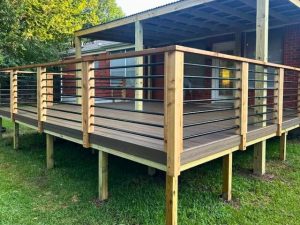
Footings sit underground and carry the deck’s load down to stable soil. They’re typically poured concrete piers, often with a metal post base anchored to the concrete. Footing assessment is the last category we check during a structural inspection because failures here lead to the most expensive remediation.
Visible footing condition: footings should be plumb, intact, and at the expected elevation. Heaving (concrete that has risen above grade) indicates soil movement beneath it, often due to drainage issues or expansive clay soil, which is typical in parts of the Central Austin urban core and the Hill Country.
Cracked footings are a signal of replacement. Concrete cracking can result from an initial undersized pour, frost heave (rare in Austin but real), or load above design capacity. Cracked footings can’t be repaired in place. They have to be removed and re-poured, which requires removing everything above them.
Post-to-footing connection: this is where many older decks fail invisibly. Posts buried in concrete (a common pre-2000 method) eventually rot at the concrete-contact point, and the rot remains hidden until structural failure. Metal post bases on top of concrete footings (current standard) are visible and inspectable.
How the Five Categories Combine
The overall framing assessment isn’t just the sum of individual category scores. It’s about which categories are failing together. Two or more categories at borderline-fail typically push toward replacement even if no single category is clearly past the line.
The most common combinations we see: joist rot plus fastener corrosion (the wood and the hardware both degrading in parallel), ledger water damage plus post-base rot (both indicating moisture management failure), and footing movement plus beam sag (load distribution problems compounding over time).
Single-category failures sometimes allow targeted repair. Multi-category failures don’t, usually.
If you’d like an honest framing assessment for an aging deck, schedule an on-site inspection, and we’ll walk through each category in detail and document the condition. We won’t recommend the scope until the assessment is complete.