
Deck Builders for Round Rock's Master-Planned Lots
Majestic builds decks across Round Rock, Texas, covering 78664, 78665, and 78681 ZIP codes. Master-planned community construction, pool deck integration on newer subdivisions, multi-level builds on grade-drop lots, and HOA-compliant design review. Fully insured. 1,000+ projects since 2016.
Round Rock’s the largest Williamson County city we serve, and the deck work here looks different from Travis County for three reasons: lots are bigger, neighborhoods are newer, and homeowner associations carry more weight than the city permit process. The housing stock concentrates between the early 2000s and the present, with master-planned communities driving most of the new-build deck demand. The Round Rock crew is fully insured for Williamson County work and is accustomed to the design review boards that run alongside the city permit process.
The ZIPs we serve in Round Rock are 78664, 78665, and 78681, which together cover the city’s residential footprint from the original older neighborhoods near downtown out to the newer master-planned communities along the south and west. Schedule a Round Rock site walk, and we’ll cover the design and material conversation that fits your specific subdivision and lot.
Neighborhoods and Project Patterns in Round Rock
Teravista is one of our most active subdivisions in Round Rock. Homes here are 10 to 20 years old on average, sitting on rolling Williamson County terrain that gives many lots usable grade drops at the back. Multi-level deck builds work well in Teravista because the natural slope supports tiered construction, and the lot sizes accommodate the extra footprint. We’ve delivered stepped multi-tier builds across Teravista that step down 6 to 10 feet over the rear yard. Our past Round Rock builds include several of these tier builds in the Teravista corridor.
Forest Creek’s an older subdivision running along the Forest Creek corridor in 78664, and it’s one of our most consistent project areas. Housing stock here runs from the late 1980s through the 1990s, with mature trees and large lots that benefit from full-platform deck builds. Many Forest Creek homeowners added pools in the early 2000s, and pool deck refurbishments are a common project type here, since the composite decking from that era has reached the end of its useful life. Composite replacement work on those aged pool surrounds runs the same crew.
Brushy Creek runs along the north side of Round Rock in 78681 and ties into Cedar Park to the west. The housing stock’s a mix of mid-1990s and 2000s tract homes, and the deck conversation usually centers on either new builds for the newer homes or replacement on the older structures. The subdivision design review board reviews any visible deck modification, which our permit partners file as part of the build.
Walsh Ranch, Sonoma, and the newer 78665 subdivisions along the east side of Round Rock are mostly 2010s and newer construction. These homes were often designed with the back patio or deck in mind from day one, which makes the build cleaner. Composite is the default material here because it matches the modern architecture and lasts longer than cedar in the full Texas sun.
The original older neighborhoods near downtown Round Rock (roughly between Mays Street and Round Rock Avenue) feature mid-century housing stock with smaller lots than the master-planned subdivisions. Refurb on existing structures is common work in these blocks, since many homes here have decks that’re 20 to 30 years old and need either targeted cedar refurbishment or full replacement.
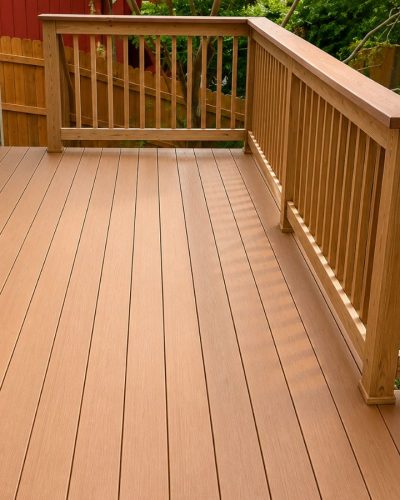
Round Rock’s homeowner association concentration is heavy. Almost every subdivision built after 1995 has an active HOA with design review that covers deck height, materials, color, and railing aesthetics. We’ll prepare the design submittal package as part of the build, since revision rounds significantly delay the project. Most associations review and approve within 3 to 4 weeks, and the approval runs parallel with the city permit.
The Williamson County permit process differs from the City of Austin’s. It is generally faster, with deck permits clearing review in 3 to 5 weeks rather than the 4 to 8 weeks the City of Austin process requires. Subdivisions outside Round Rock city limits fall under unincorporated Williamson County rules, which apply across a few of the newer development edges. We’ll map the specific jurisdiction at the site walk.
Material choices in Round Rock lean strongly toward composite for new builds, and it’s rare we’d recommend cedar for the master-planned subdivisions, where modern architecture suits gray and charcoal composite tones better than natural cedar. Older subdivisions like Forest Creek and the downtown-adjacent neighborhoods still see significant cedar work, since the traditional architecture wears cedar planks well. We’ll bring physical samples to the site walk, so the material reads correctly against the home’s existing exterior.
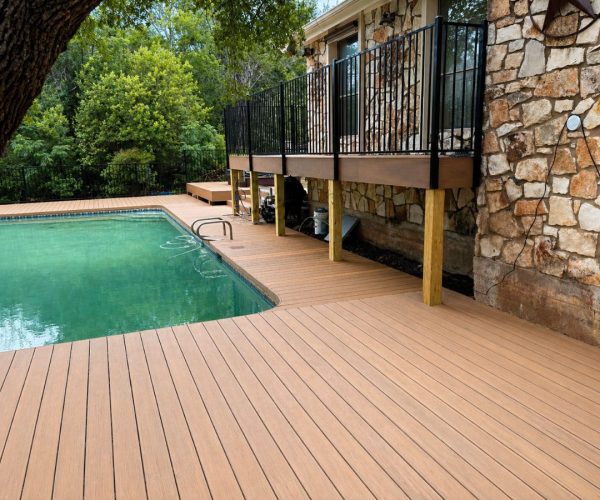
Pool deck integration runs heavy in Round Rock because many master-planned subdivisions added community and private pools in the 2000s and 2010s. The deck-to-pool transition’s a different conversation from standalone deck work, covering expansion gaps, drainage routing, and slip-resistant texture. We perform extensive pool deck construction throughout Teravista, Forest Creek, and the 78664 corridor.
We also serve the surrounding Williamson and Travis County markets. Round Rock homeowners sometimes have rental property or family homes elsewhere, and we handle work in Cedar Park and Georgetown with the same crew.
We also cover South Austin and the broader inner-Austin section pages. The constraints vary across markets, but the build cadence we apply remains consistent across the metro.
Frequently Asked Questions — Round Rock Deck Projects
Which Round Rock ZIP codes do you serve?
We work across 78664 (central and southwest Round Rock, including Forest Creek), 78665 (eastern Round Rock and Walsh Ranch area), and 78681 (northern Round Rock, Teravista, and Brushy Creek). These cover the city’s full residential footprint, from older neighborhoods near downtown to newer master-planned communities. Adjacent Williamson County ZIPs are handled on a case-by-case basis, but they’re rare exceptions.
How active are HOAs in Round Rock subdivisions?
Very. Almost every Round Rock subdivision built after 1995 has an active homeowners’ association with design review that covers deck height, materials, color, and railing aesthetics. We’ll prepare the design submittal package as part of the build, and most associations review and approve within 3 to 4 weeks. That’s a parallel process with the city permit, not a sequential one, so it doesn’t add to the total timeline.
Do you handle pool deck integration on Teravista and Forest Creek homes?
Yes. Pool deck integration is one of our most common project types in Round Rock, and it’s where master-planned subdivisions are concentrated. Many Teravista and Forest Creek homes added pools in the 2000s, and the original surrounds have reached the end of useful life. We’ll cover the technical details at the site walk: expansion gaps, drainage routing, slip-resistant texture, and chlorine-rated materials at the pool edge.
What's the Williamson County deck permit timeline?
Williamson County and City of Round Rock permits typically clear review in 3 to 5 weeks, which’s faster than City of Austin, which’s faster than the 4 to 8 weeks City of Austin work requires. HOA review adds 3 to 4 weeks running parallel with the city permit. That isn’t a sequential process. Subdivisions outside Round Rock city limits fall under unincorporated Williamson County rules, which we’ll map at the site walk.
Can you build multi-level decks on Teravista's grade-drop lots?
Yes, and the rolling Williamson County terrain throughout Teravista is well-suited to stepped, multi-level construction. We’ve delivered builds that step down 6 to 10 feet over the rear yard, using the natural slope rather than fighting it. Multi-tier construction needs more engineering attention and isn’t a one-size-fits-all approach compared to single-platform builds, especially on hillside lots where structural support must handle both vertical and lateral loads.
Is composite or cedar the better fit for Round Rock homes?
It’ll depend on the subdivision and home era. New builds in the master-planned communities (Teravista, Walsh Ranch, Sonoma) usually suit composite better, since the modern architecture reads cleanly with gray or charcoal finishes. Older subdivisions like Forest Creek and the downtown-adjacent neighborhoods still see significant cedar work because traditional architecture wears cedar planks well. We’ll bring samples to the site walk.
Do you handle Brushy Creek and northern Round Rock work?
Yes, this ‘s one of our regular service areas. Brushy Creek straddles the 78681 ZIP and ties into Cedar Park to the west, so we’re often working in both cities on the same week. The housing stock’s a mix of mid-1990s and 2000s tract homes, and the design conversation covers new builds for newer homes and replacement work on the older structures that’ve reached the end of useful life.