
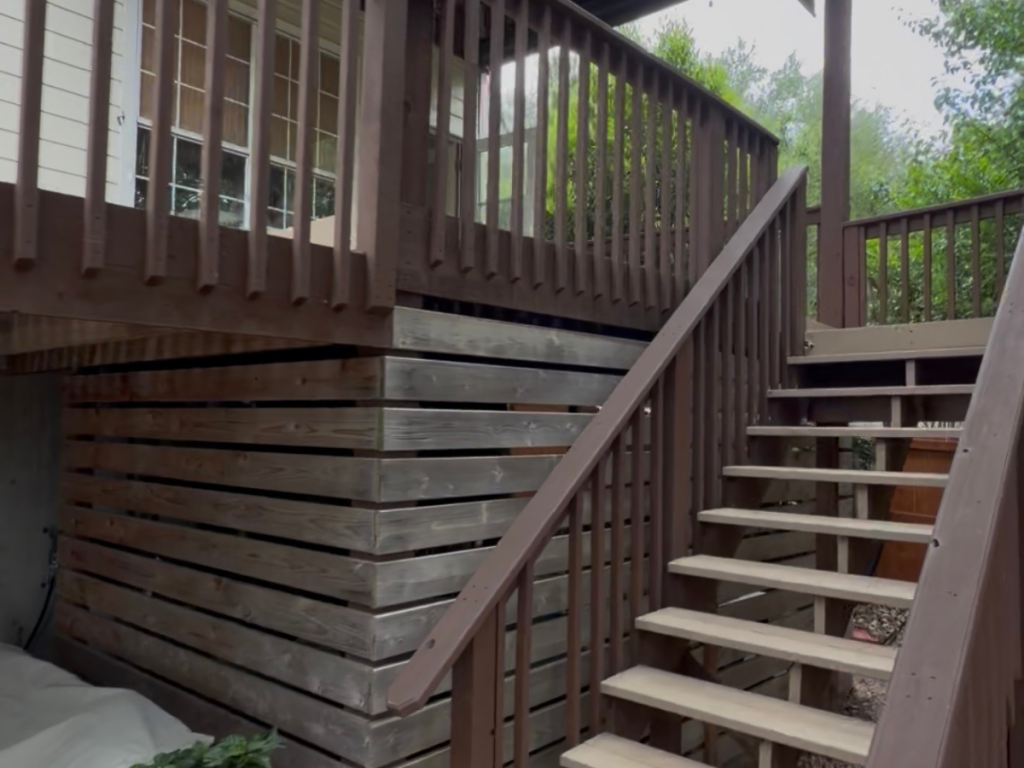
Most homeowners reach out about deck repair before they’ve considered replacement. That’s natural. Repair sounds smaller, cheaper, and less disruptive. But some structural conditions cross a line where another repair isn’t the honest answer, and continuing to use the deck in that condition becomes a safety problem. Knowing the signs up front helps you have the right conversation with your contractor, rather than paying for repair work that won’t last.
This guide walks through 10 specific conditions that tip an aging Austin deck from repair territory into replacement territory. For the broader decision framework, our repair vs replacement guide covers that decision in full. The build team inspects for each of these conditions at every assessment we run across Hays, Travis, and Williamson counties.
1. Ledger Separation From the House
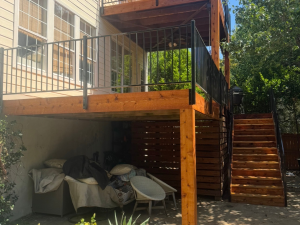
The ledger’s the board that attaches the deck to the house. It carries most of the deck’s load. If you can see or feel a gap between the deck attachment and the house wall, the ledger has failed or is actively failing. This isn’t a repair condition. It’s a stop-using-the-deck condition.
Ledger separation almost always means water has gotten behind the deck-to-house connection. Once water’s in there, it damages the house’s structural framing as well as the deck itself. By the time visible separation shows up, the damage typically extends back into the wall behind the siding. Replacement work at this point usually includes removing siding and repairing the house framing before the new deck can be built.
2. Widespread Rot in Joists or Beams
Joists and beams are the structural ribcage of the deck. A few small areas of surface staining sit in repair territory. Brown discoloration that crumbles when pressed indicates active rot, and multiple affected members across the deck mean the structural framework is compromised.
We’ve inspected hundreds of decks across Hays, Travis, and Williamson, and the threshold we apply is consistent. If more than 20 percent of joists or beams show structural rot (not surface weathering), the deck is in replacement territory. Selective joist replacement is theoretically possible, but it is rarely cost-effective at that scale. By the time you’ve replaced a third of the framing, you’ve paid for replacement-level work and ended up with a partly-old deck.
3. Fastener Corrosion Across Multiple Boards
When we walk on a deck, we first look at the screws or nails across the surface. Rust streaks running down boards, fastener heads lifting above the surface, fastener heads sinking below the surface, or visible green-blue corrosion all indicate the hardware has reached the end of its life.
Why this matters more than most homeowners realize: even sound wood can’t stay structurally safe with failed fasteners. Every connection across the deck (board-to-joist, joist-to-beam, beam-to-post) relies on fasteners holding tight. Widespread corrosion means widespread connection failure. Replacing every fastener across an existing deck typically requires removing every board, which is a replacement-level disruption for a repair-level outcome.
4. Heaving or Cracked Footings
Deck footings sit underground or just below grade and carry the deck’s vertical load down to stable soil. If you can see footings that have shifted (concrete tilted, posts no longer plumb), cracked through, or risen above their original elevation, the footing system has failed.
Footing failure isn’t repairable through the deck, in our experience. You can’t fix a failed footing without removing the post that sits on it, and removing the post requires deconstructing whatever sits above it. Most deck builds with failed footings end up as full structural replacement projects because the foundation has to be rebuilt before anything else.
5. Loose or Rotting Posts
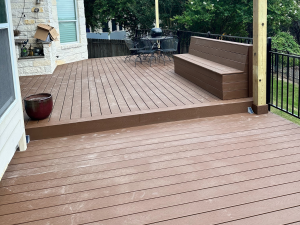
Deck posts carry the deck’s load from beams down to footings. They’re typically 4×4 or 6×6 lumber set in concrete or on metal post bases. Two failure conditions move a deck into replacement territory.
Loose posts: if you can push a post, and it moves at the base, the connection to the footing has failed. Common in older decks where posts were buried directly in concrete with no metal post base, or where the post base hardware has corroded through.
Rotting posts: Rot at the base of posts (the bottom 6 to 12 inches where the post meets ground or concrete) is the most common post failure in Austin. Texas humidity plus standing moisture at the ground contact accelerates decay. Routine deck care slows this, but it can’t reverse decay once it’s set in. Visible rot at post bases across multiple posts means the deck’s structurally compromised. We catch this during the assessment phase before any work commits to a path.
6. Decaying Stair Stringers
Stair stringers carry concentrated load. The diagonal boards that support stair treads experience higher stress per square inch than horizontal deck framing, and they’re typically more exposed to weather. Visible rot, splits, or sagging in stair stringers is a fall hazard, not a cosmetic issue.
Stair stringer replacement is technically possible without full deck replacement, but stringer decay almost always indicates broader structural issues elsewhere in the deck. By the time stair stringers have visibly failed, a full structural assessment usually finds problems in the joists and beams, too.
7. Surface Cupping Past 30 Percent of Boards
Surface boards that no longer sit flat (with a visible curve across the width of the board) indicate that the wood has lost dimensional stability. Some cupping is normal in aged cedar decks. Widespread cupping (30 percent or more of the surface boards) means the wood has degraded beyond the surface treatment.
Replacing 30+ percent of surface boards already approaches replacement cost. At that scale, you’re paying replacement money for a partial outcome. Unless the structure below is solid, and you’re specifically committed to keeping it, full replacement usually delivers better long-term value.
8. The Deck Was Built Before 2010 With Original Fasteners
Pre-2010 deck construction in Texas often used standard galvanized fasteners, which don’t hold up to ACQ-treated lumber over the long term. The chemical interaction between ACQ treatment and standard galvanization accelerates corrosion. Current cedar deck builds use stainless or hot-dipped galvanized fasteners specifically rated for ACQ contact. By year 15, hardware throughout the structure is typically failing regardless of how the wood looks.
This isn’t visible until you start opening things up. We’ve inspected pre-2010 decks where the wood looked acceptable, but every joist hanger was rusted through. Those decks are replacement candidates regardless of surface condition, and continuing to use them under load is genuinely unsafe.
9. The Original Build Used Substandard Structural Detail
Not all aging decks failed because of age. Some failed because they were built with shortcuts: undersized joists, inadequate post spacing, missing joist hangers, ledger boards attached with nails rather than lag bolts or structural screws, and no flashing detail between the deck and the house.
These shortcuts often don’t show up as obvious failures for 10 to 15 years, and then they become catastrophic. By the time visible problems appear, the structural compromise is typically widespread enough that repair doesn’t address the root issue. Full replacement of the current building code is usually the right path.
10. The Deck Is Past Its Material Lifespan
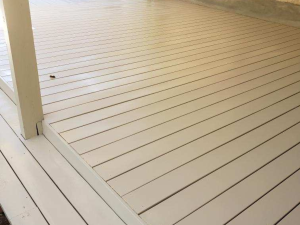
Materials have realistic lifespans. Cedar runs 20 to 25 years with on-schedule maintenance, less without. Cedar lifespan in Austin specifically varies by lot exposure and care history. Composite runs 25 to 30 years for current-generation products, less for pre-2010 composite. Pressure-treated wood lasts 12 to 18 years. A deck past these brackets is replacement territory regardless of how the surface looks.
The failure modes change as decks age past their material lifespan. The surface looks decent because it has been refinished. Internal degradation continues silently. Joists harden and become brittle. Fasteners corrode invisibly behind boards. The deck eventually fails not from a single identifiable cause but from the cumulative breakdown of materials across many small failures.
If your deck’s past its material lifespan, even a clean structural inspection today doesn’t mean it’ll stay safe for the next five years. Schedule a condition assessment, and we’ll walk through the structural age, current condition, and realistic remaining life of your deck. Past assessments and outcomes across the metro show what the structural inspection actually finds in real situations.