
Deck Builders for South Austin's Mature-Tree Lots
Majestic builds decks across North Austin, Texas, covering 78727, 78729, 78757, 78758, and 78759 ZIP codes. Suburban tract-home decks, larger backyard lots, pool deck integration, and multi-level builds on grade-drop properties. Fully insured. 1,000+ projects since 2016.
North Austin’s deck market differs from Central and East Austin in three ways: lots are larger, homes are newer, and design constraints come more often from homeowner associations than from the City of Austin’s historic and tree ordinances. The housing stock here runs from the late 1970s through the 1990s, with newer infill in the Wells Branch and Walnut Creek corridors. That’ll change the deck conversation entirely. Most of our work here is new deck installation on suburban tract homes. Majestic’s team is fully insured and runs the suburban North Austin work with a different design playbook than it uses for inner-loop neighborhoods.
The ZIPs we serve in North Austin are 78727, 78729, 78757, 78758, and 78759. Get a site walk scheduled, and we’ll cover the design and material conversation that fits your specific North Austin neighborhood.
Neighborhoods and Project Patterns in North Austin
Allandale and Crestview anchor the 78757 corridor. They’re the closest part of North Austin to the inner loop. These neighborhoods feature mid-century housing stock, mature trees, and surprisingly large lots for inner-Austin pricing. Heritage tree protection is a factor here more than the rest of North Austin, since 50-year-old pecans and live oaks are common. We’ll design Allandale and Crestview deck builds around the root zones, and we’ve delivered several builds in these neighborhoods that work around protected trees without compromising the footprint.
Wells Branch is the largest single residential area in North Austin, and it’s where most of our suburban work is concentrated, spanning 78728 and 78729. The housing stock here runs late-1970s through early 1990s, with bigger backyards than the inner loop and the city’s most concentrated set of homeowner association rules. Almost every Wells Branch subdivision’s got design review requirements covering height, materials, and railing styles. We’ll handle the homeowner association submission as part of the build, since revision rounds delay the city permit.
Anderson Mill, Mesa, and the Far North Austin corridor along 183 sit in 78729 and 78759. These are larger suburban lots, and they often have grade drops at the back of the property, which makes stepped, multi-level builds practical. We’ve delivered stepped designs in Anderson Mill that’ll drop 8 to 12 feet over a 30-foot run, using the grade rather than fighting it.
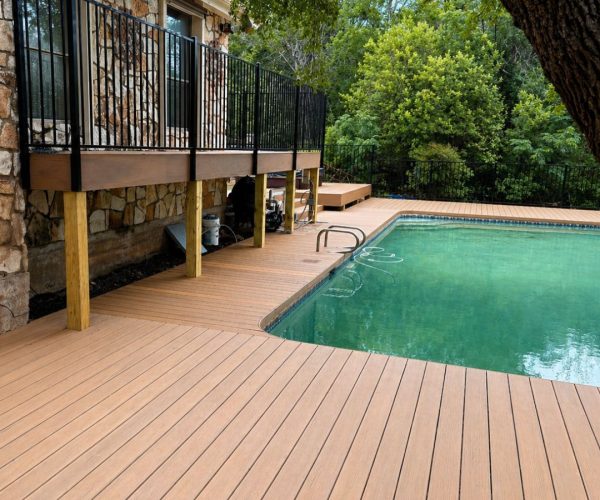
Walnut Creek and the Parkfield corridor in 78758 carry mid-to-late 1980s tract homes on quarter-acre lots, with mature trees and Walnut Creek itself running through several neighborhoods. Pool deck integration is one of the most common project types in this corridor, since these tract homes often added pools in the 2000s,s and the deck-pool transition needs attention. We perform extensive pool surround construction in Walnut Creek and Parkfield.
Brentwood and Highland sit further south in the 78757 ZIP, transitioning between inner-loop Central and true North Austin. Lots here are slightly smaller than those in Wells Branch but larger than those in Hyde Park. Mid-century housing is the norm, and refurbishing existing decks on 30 to 40-year-old structures is common work. We’ll approach these as either targeted repair (when the structure’s still sound) or full replacement (when underlying framing has aged out).
North Hills, Mesa, and the blocks east of 183 fall in 78759. These are larger single-family lots, often with composite decks installed 8 to 15 years ago, that are nearing the end of their useful life. Composite decking from that era is materially different from current composite decking, and a full replacement with current Trex Pro materials is usually the right call. Replacement work on these older composite decks is a regular conversation in the 78759 corridor.
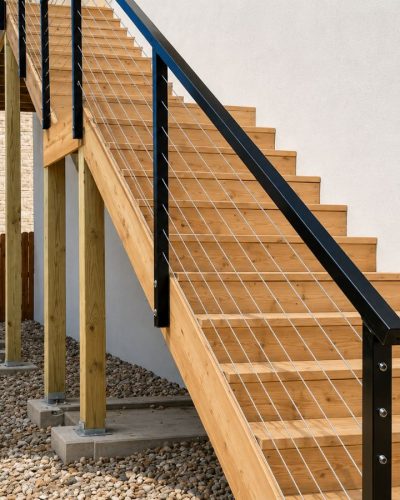
Material choices in North Austin’ll lean toward composite for the suburban tract homes and newer construction, and toward refinishing existing cedar where structures are still sound. The tract-home aesthetic’s a clean fit for modern composite, and the lot sizes accommodate full-platform builds rather than the compact designs East and Central Austin require. We’ll bring physical samples to the site walk, so the material reads correctly against the home’s exterior.
Homeowner association rules’ll drive more of the design conversation in North Austin than the City of Austin’s permit process. Wells Branch, Anderson Mill, and Mesa all have active design review boards, and approval rounds determine the schedule more than the city permit itself does. We’ve completed homeowner association submissions across all three areas and are familiar with the review board’s preferences for materials, colors, and railing aesthetics.
The permit and review timeline for North Austin work runs longer than it might look on paper. The City of Austin permitting process takes 4 to 8 weeks, but the homeowner association review adds another 3 to 6 weeks, running in parallel. Subdivisions outside Austin city limits (parts of 78729 and 78727) fall under unincorporated Travis County rules, which operate under a different framework. We’ll map the specific jurisdiction at the site walk.
We also serve other Austin areas and the suburban cities farther from North Austin. Our recent builds include work for North Austin homeowners who sometimes have rental property in South Austin, Round Rock, or Cedar Park, and we handle work across the metro with the same crew. The constraints shift as you move from Wells Branch to Cedar Park, but the build standards we apply stay consistent across the metro.
Frequently Asked Questions — North Austin Deck Projects
Which North Austin ZIP codes do you serve?
We work across 78727 (Anderson Mill area), 78729 (Wells Branch corridor), 78757 (Allandale, Crestview, Brentwood), 78758 (Walnut Creek, Parkfield), and 78759 (Mesa, North Hills). These are the suburban and far-north neighborhoods with larger lot sizes and a concentration of homeowner associations that define our North Austin work. Adjacent ZIPs are handled on a case-by-case basis.
How active are homeowner associations in North Austin neighborhoods?
Very active. Wells Branch, Anderson Mill, Mesa, and most of the 78729 corridor have homeowner associations with design review boards covering height, materials, color, and railing aesthetics. We’ll prepare and submit the design for review as part of the build process, so that revision rounds don’t delay the project. The association approval runs in parallel with the city permit, adding 3 to 6 weeks to the overall schedule.
Do you handle pool deck integration on existing North Austin pools?
Yes. Pool deck integration is one of the most common project types we run in the Walnut Creek and Parkfield corridors, where tract homes from the 1980s and 1990s added pools in the 2000s. The deck-pool transition’s got to handle expansion gaps, drainage routing, and slip resistance differently than a standalone deck. We’ll cover the technical details at the site walk before pricing comes up.
Can you build multi-level decks on Anderson Mill's grade-drop lots?
Yes, and the grade drops in Anderson Mill and parts of Mesa are well-suited to stepped multi-level construction. We’ve delivered builds that drop 8 to 12 feet over a 30-foot run, using the natural grade rather than fighting it. Multi-level work requires more engineering attention than single-platform builds, so we don’t shortcut the load calcs, especially on hillside lots where structural support must handle both vertical and lateral loads.
How old is too old for a composite deck before full replacement makes sense?
Composite decking installed 12 to 15 years ago is materially different from the current generation product. Older composites often degrade faster than expected, with surface mottling and edge softening that the current Trex Pro composite doesn’t show. If the original composite is over 10 years old and showing surface issues, full replacement with current materials usually pencils better than partial board swaps. We’ll inspect the site and give you an honest assessment during the site walk.
Are the unincorporated Travis County rules different from the City of Austin?
Yes. Parts of 78729 and 78727 fall within unincorporated Travis County rather than the City of Austin’s city limits, which means deck construction follows Travis County rules rather than Austin’s permitting process. The county rules are generally less restrictive, but the homeowner association rules don’t change either way. We’ll map the specific jurisdiction at the site walk, since which set of rules applies depends on the exact address.
Does Allandale's mature tree canopy affect deck design?
Often, yes. Allandale and Crestview carry mature 50-year-old pecans and live oaks, and Austin’s tree ordinance protects any specimen over 19 inches in diameter. We design Allandale builds to route footings outside protected root zones and coordinate with an arborist when the design impacts a heritage tree. Tree preservation typically shapes the deck’s footprint and layout, not the other way around.